
Securing your home has never been more important, and in the UAE, where modern living meets cutting-edge technology, homeowners are making the switch from traditional locks to smarter solutions. But with so many options flooding the market, choosing the right smart door lock can feel overwhelming, especially if you are new to home automation.
The good news is that once you know what to look for, the decision becomes much simpler. A quality smart door lock does more than just replace your keys. It gives you control, convenience, and peace of mind, whether you are at home or halfway across the world.
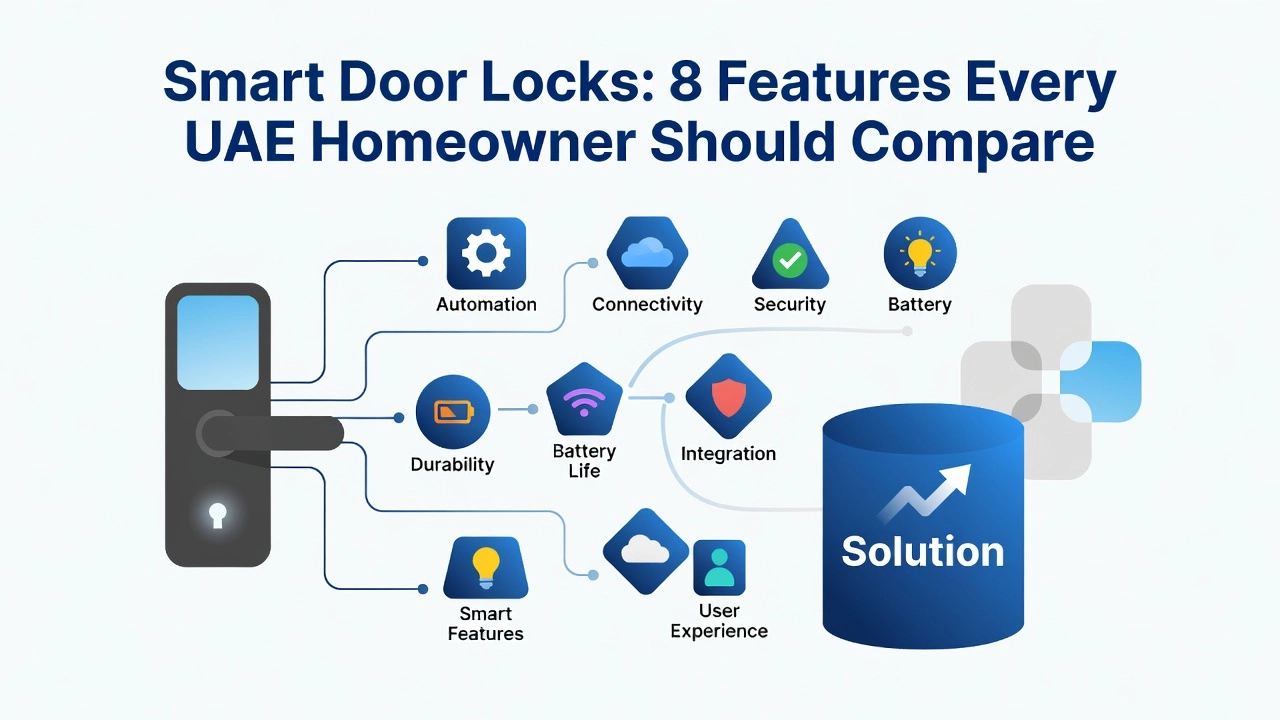
In this guide, we have broken down the eight most important features you should compare before making your purchase. From connectivity options and access methods to battery life and local compatibility, each feature plays a role in how well your lock will serve your household. By the end of this post, you will have a clear, confident understanding of exactly what separates a great smart lock from one that simply looks the part. Let us get started.
Multiple Authentication Methods: Why One Entry Option Is Never Enough
Relying on a single entry method is one of the most common mistakes first-time smart lock buyers make. Real-world conditions are unpredictable: phone batteries die, fingers get wet after washing dishes, and keypads can occasionally malfunction. A smart door lock that offers only one way in is, by definition, a single point of failure at the worst possible moment.
The good news is that authentication technology has become genuinely affordable. Biometric sensor costs have fallen approximately 38% since 2021, bringing fingerprint recognition and facial recognition out of the premium-only tier and firmly into mid-range price points. This shift means you no longer need to pay a luxury premium to access layered security. According to Precedence Research, the global smart locks market is projected to reach USD 17.10 billion by 2034, driven significantly by this democratisation of biometric technology.
Keypad-based authentication remains a cornerstone of the market, holding roughly 45% of global smart lock market share in 2025. For rental properties and shared households across Dubai, PIN-based entry is particularly valuable because landlords and hosts can issue temporary guest codes remotely, then revoke them instantly after checkout. No physical key handover is required.
Multi-factor authentication, combining fingerprint, PIN, and mobile app access, creates a practical redundancy framework. If your phone battery is flat, use your fingerprint. If your finger is damp, enter your PIN. This layered approach ensures at least one method is always available.
The Keyin L and Keyin LX are built precisely around this principle. Both models support fingerprint recognition, password entry, and mobile app unlocking as independent, simultaneous access options, with facial recognition available as an optional expansion layer. When evaluating any smart door lock, prioritise models offering a minimum of three independent entry methods, giving you genuine resilience against any single system failure.
Mobile App Control and Remote Access Management
Mobile app control has become the dominant access method in the smart lock category, with app-based unlocking projected to capture 38% of the residential smart lock unlocking mechanism segment, making it the single largest consumer preference ahead of keypad or standalone biometric methods. This reflects a broader shift toward smartphone-centric home management, where one device handles everything from banking to physical entry.
Remote access functionality is particularly valuable in Dubai's short-term rental and holiday home market. Hosts managing properties through short-stay platforms need to issue time-limited access codes to arriving guests and revoke them immediately at checkout, all without being physically on site. This eliminates the logistical burden of key handoffs, reduces security exposure between tenancies, and allows a single host to manage multiple units across different emirates simultaneously.
When evaluating any smart lock app, real-time access logs are a non-negotiable feature for serious property managers. A quality app records exactly who entered, through which method, and at what time, surfacing that data instantly as a push notification or within a searchable log history. Managers overseeing several units depend on this granular audit trail to verify contractor access, confirm guest check-ins, and investigate any unusual activity.
One often-overlooked cost consideration is whether remote access features require a paid monthly subscription. Some manufacturers gate cloud-based functionality behind recurring fees, which adds meaningfully to the total cost of ownership across a portfolio of properties.
The Keyin mobile app avoids this friction entirely. With full IoT-connected remote control included, homeowners and property managers can lock or unlock doors from any location with a data connection, with no ongoing subscription required. For those exploring how smart lock connectivity works in practice, Smart Lock Statistics provides a useful breakdown of current consumer adoption patterns across access methods.
IoT and Smart Home Integration: Future-Proofing Your Investment
The modern smart lock has evolved far beyond a simple keyless entry device. Today's leading locks are designed as foundational nodes within connected home ecosystems, working alongside lighting controls, HVAC systems, and security cameras to create fully automated living environments. When you lock your door on the way out, a properly configured smart lock can simultaneously switch off every light, lower the air conditioning to an energy-saving mode, and arm your camera system, all triggered by a single action.
A significant development making this integration more accessible is the Matter 1.2 interoperability standard, which has unified over 40 smart lock SKUs into a single cross-brand control layer. As confirmed by the Matter innovations showcased at CES 2026, adoption is accelerating rapidly across major manufacturers. The practical benefit for buyers is reduced ecosystem lock-in risk; a Matter-compatible lock can communicate with Apple Home, Google Home, and Amazon Alexa simultaneously, without forcing you to commit to one platform.
The Keyin LX addresses this integration demand directly, featuring built-in IoT connectivity that supports broader smart home platform compatibility and enables voice assistant and automation functionality. This makes it a practical long-term investment rather than an isolated upgrade.
One purchasing consideration that beginners frequently overlook is whether IoT integration is native to the lock or requires a separately purchased hub. Some locks advertise smart home compatibility but only deliver it through additional hardware that adds cost after purchase. Before committing, confirm exactly what the listed price includes, since hidden hardware requirements affect your true total cost of ownership considerably.
Fire-Rated Construction and Thermal Sensors: A Feature Most Buyers Overlook
When shopping for a smart door lock in the UAE, most buyers focus on fingerprint recognition, app connectivity, and design aesthetics. Fire-rated construction rarely enters the conversation, yet it carries significant legal and safety weight in this market.
UAE Civil Defence regulations mandate fire-rated door assemblies across a wide range of building types, including stairwell enclosures in buildings over two storeys and lift lobby enclosures in buildings over four storeys. The critical detail that most buyers miss is this: when a door carries a fire-resistance rating, every component fitted to that door, including the lock, must maintain that rating. A non-rated lock body can compromise the integrity of the entire fire-rated door assembly. During Civil Defence inspections, hardware including locks is one of the most commonly cited compliance failure points, meaning this is a documented regulatory obligation, not a theoretical concern.
The compliance gap in the mainstream smart lock market is substantial. Most imported smart locks are engineered for convenience and connectivity; fire-rated construction requires complete engineering redesign using flame-retardant materials, thermal cutoff switches, and mechanical failover systems. Passing a recognised standard such as EN 1634-1 certification requires a lock to maintain full functionality under extreme heat conditions. Very few smart locks available in the UAE carry this certification, and standard product comparisons rarely mention it.
Beyond passive fire resistance, thermal sensors add an active safety layer. A sensor embedded in the lock body monitors temperature at the door frame continuously. When it detects an abnormal temperature rise, it triggers an alert and can automatically unlock the door to enable safe evacuation before a fire reaches a critical stage. This is a meaningful distinction: passive fire-rated construction protects the door assembly; active thermal detection protects the occupants.
The Keyin L and Keyin LX address both requirements directly. Built with a fire-rated zinc die-cast body engineered by RAONARK Korea, and fitted with built-in thermal sensors, these locks are among the very few smart lock options in the UAE market designed to meet fire safety obligations rather than simply ignore them.
Before finalising any smart lock purchase for a fire-rated door, ask your supplier to confirm the following:
Whether the door is fire-rated and what classification applies (FD30, FD60, FD90, or FD120)
Whether the lock carries a fire-resistance test certificate to BS 476 Part 22, EN 1634-1, or UL 10C from an accredited laboratory
Whether the lock includes an active thermal sensor with automatic unlock functionality
Whether the complete door assembly, including the lock, maintains its fire rating post-installation
Certificates from non-accredited bodies are not accepted by UAE Civil Defence, so verification of the issuing laboratory matters as much as the certificate itself.
Build Quality and Security Certifications: What the Spec Sheet Does Not Always Tell You
Electronic features attract attention on a spec sheet, but physical construction determines whether a smart door lock actually keeps intruders out. A determined attacker will not attempt to crack encrypted Bluetooth or guess a six-digit PIN; they will drill through the cylinder, pick the lock mechanism, or apply brute force to a short bolt throw. Anti-drill protection (hardened steel plates positioned behind the cylinder face), pick-resistant pin configurations, and a bolt throw of at least 20 mm are foundational requirements that many product listings simply omit. Always treat physical resistance as the security foundation; electronic access features sit on top of that foundation, not in place of it.
Marketing language is equally unreliable as a quality signal. Terms such as "military-grade" or "ultra-secure" carry no standardised definition and cannot be independently verified. Instead, look for reference to certifications from recognised testing bodies: ANSI/BHMA Grade 1 for the highest commercial security standard, EN 12209 under European norms, and IP65 or above (per IEC 60529) for dust and moisture ingress protection. Ask any supplier to share certification numbers or test documentation directly; a credible manufacturer will provide this without hesitation, and reluctance to do so is a warning sign worth taking seriously. The UAE smart door lock market attracts parallel-imported and unbranded products alongside certified hardware, making this verification step especially important locally.
Weather resistance deserves specific attention in the UAE context. Outdoor-facing door panels face ambient summer temperatures exceeding 45°C, direct sun exposure that drives surface temperatures considerably higher, fine dust from seasonal storms, and humidity spikes in coastal locations. An IP65 rating is a practical minimum for any UAE outdoor installation.
RAONARK Keyin locks are built to commercial-grade standards, with hardware engineered to handle both the UAE's environmental extremes and physical tampering attempts. This means documented material specifications and construction designed for long-term performance, not just feature-list appeal.
Finally, treat mechanical and electronic robustness as a single combined standard. A lock with sophisticated app control but a thin zinc alloy body and a short bolt throw offers a false sense of security. Evaluate both columns before purchase.
Professional Installation and Site Survey: Why DIY Is a Hidden Risk in the UAE
Many smart locks sold globally are designed as straightforward DIY retrofit products, built around standardised North American or European door preparations. UAE residential properties tell a different story. Villas in established communities, apartments in older Deira buildings, and newer developments across Abu Dhabi frequently feature non-standard mortice lock backsets, varied door thicknesses, and fire-rated door assemblies sourced from European or Asian suppliers. These configurations do not align with the assumed dimensions of most DIY-marketed locks. As OjiSmart's technical installation guide for Dubai confirms, local door configurations require specific assessment before any hardware is fitted.
The consequences of skipping that assessment are serious. An incorrectly seated lock mechanism can create mechanical binding that burns out the motor within months. A misaligned strike plate reduces physical security, defeating the purpose of upgrading your lock entirely. Most critically, any unauthorised modification to a fire-rated door assembly can void the door's fire rating, a significant liability in UAE buildings where Civil Defence compliance is mandatory.
A pre-purchase site survey eliminates these risks entirely. A trained installer measures backset depth, checks door thickness, assesses the existing frame and strike plate, and flags any preparatory work required before the lock is ordered. Nothing is left to guesswork.
Keyin.ae provides a complimentary site survey and professional installation service covering all seven emirates. The service includes full hardware fitting and complete mobile app configuration, so the system is fully operational on the day of installation. No separate IT visit is required.
When calculating total cost, factor in that installation services elsewhere can add AED 200 to AED 500 or more on top of hardware prices. With Keyin.ae, that cost is included from the start.
Price and Value in the UAE Market: Understanding What You Are Actually Paying For
The global residential smart lock market was valued at approximately USD 3.77 billion in 2026 and is forecast to reach USD 10.61 billion by 2036, a trajectory that reflects sustained consumer demand while simultaneously intensifying hardware competition. That competition is consequential for UAE buyers because it has driven meaningful price moderation at the mid-range tier, making genuinely capable products more accessible than they were even three years ago.
Biometric Costs Have Fallen Significantly
Capacitive fingerprint sensor costs have declined approximately 38% since 2021, and facial recognition modules have followed a similar curve. The practical result is that biometric authentication is no longer confined to high-end, premium-priced hardware. Mid-range products today can legitimately offer multi-factor biometric access without inflating the purchase price, which means fingerprint and facial recognition should now be expected features rather than aspirational upgrades when you are evaluating options in the UAE market.
What AED 1,499 Actually Includes
The Keyin L and Keyin LX smart locks start from AED 1,499, and understanding what that price bundles matters enormously. That starting figure covers multi-factor biometric authentication, IoT connectivity, fire-rated door construction compatibility, built-in thermal sensors, and professional installation support with app setup. Comparing that against a lower headline price is misleading if the alternative requires a separate connectivity hub, a paid app subscription tier, and a charged installation call-out, costs that can individually add AED 150 to 400 each to the real purchase total.
Insurer Benefits Worth Investigating
Insurers in the US and UK currently offer 5 to 15% premium reductions for certified smart lock installations, and some international insurers operating in the UAE and broader GCC are beginning to align with those assessment frameworks. This is not a confirmed or standardised benefit in the UAE at this time, so treat it as an emerging consideration rather than a guaranteed saving. Contact your home insurer directly before purchasing to ask whether a certified smart lock installation affects your policy assessment. The question alone often prompts a useful conversation about your overall home security rating.
Matching the Right Lock to Your Use Case: Home, Rental Property, or Commercial Space
Not every smart lock buyer has the same requirements, and selecting the wrong configuration for your specific context is a costly mistake that a quality installation partner should help you avoid before you spend a single dirham.
Dubai Homeowners
For residential buyers in Dubai, the priorities are seamless daily use, a finish that complements contemporary interiors, and compatibility with an existing smart home setup. Multi-factor authentication combining fingerprint, PIN, and mobile app access delivers the convenience and backup redundancy that household routines demand. As biometric sensor costs have fallen approximately 38% since 2021, advanced authentication is now accessible at mid-range price points rather than premium tiers, making it a realistic expectation for any serious residential purchase.
Short-Term Rental Hosts and Holiday Home Operators
Dubai's licensed holiday home sector places distinct operational demands on access hardware. Hosts need the ability to issue unique PIN codes remotely before a guest arrives, monitor entry and exit timestamps through an access log, and revoke codes instantly between stays, all without any physical key handover. Keypad-based authentication held approximately 45% of global smart lock market share in 2025 precisely because this flexibility is so valued in rental contexts. A lock that cannot deliver remote credential management creates unnecessary risk and administrative friction between bookings.
Property Managers With Multi-Unit Portfolios
Managing access across a portfolio of apartments or villas through separate physical keys is an inefficient and security-vulnerable approach. A single app dashboard that displays and controls multiple locks across different properties reduces the administrative overhead considerably, and IoT connectivity enables real-time monitoring across the entire portfolio from one interface.
Commercial and Hospitality Settings
Commercial environments require a different specification entirely. Lever handle smart lock systems are forecast to grow at a 16.3% CAGR through 2035, driven by office and hospitality deployments that demand fire egress compliance, high daily cycle durability, and integration with property management systems.
How Keyin.ae Approaches This
Keyin.ae serves homeowners, rental operators, portfolio managers, and commercial clients across all seven emirates. The free site survey is specifically designed to identify the correct model and configuration for each use case before any purchase commitment is made, ensuring that the lock installed matches the environment it will operate in.
The Smartest First Step Before You Buy
Every smart door lock decision comes down to eight variables: authentication methods, app control, IoT integration, fire-rated construction, build quality certifications, professional installation, total cost of ownership, and use case fit. Work through each one systematically and a previously overwhelming purchase becomes a structured, manageable choice.
The UAE market adds a layer of complexity that global product pages simply do not address. Fire-rated door compatibility is a regulatory requirement in most multi-storey residential and commercial buildings across the emirates. Sustained outdoor temperatures exceeding 45°C affect battery performance, touchscreen responsiveness, and long-term hardware integrity in ways that temperate-climate testing standards never capture. These are not minor considerations; they are the difference between a compliant, long-lasting installation and an expensive mistake.
No product page can answer every question specific to your property, door preparation, building management rules, and budget. That is precisely where a professional site survey fills the gap.
Book a free site survey with Keyin.ae and get a recommendation tailored to your property and budget, with no obligation to purchase. A qualified advisor will assess your door, confirm fire-rating compatibility, evaluate climate exposure, and match you to the right lock configuration before a single dirham is committed.
Conclusion
Choosing the right smart door lock does not have to be complicated. By focusing on the eight key features covered in this guide, including connectivity, access methods, battery life, and local compatibility, you are already ahead of most buyers. The right lock should fit your lifestyle, integrate with your existing setup, and give you genuine peace of mind every single day.
Smart security is one of the best investments a UAE homeowner can make right now. Technology is advancing quickly, and the gap between average locks and great ones comes down to knowing what questions to ask.
Now it is your turn to take action. Use this guide as your checklist the next time you shop, compare models side by side, and choose a lock that truly works for your home. Your front door deserves nothing less than your best decision.